Uniform Thickness
- High Pressure
- Flexible

Welcome To Divyajyot Pipe Stores
Maharashtra, India
(Monday - Friday)
(9 To 5 Working Hours)

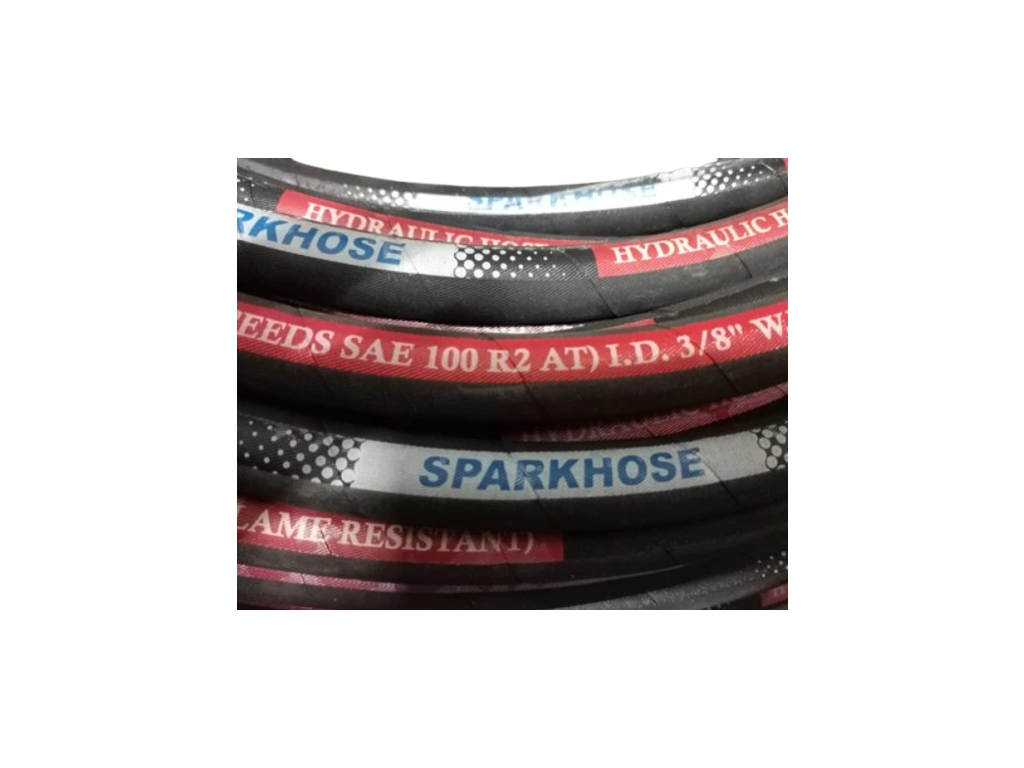
Uniform Thickness
Rubber Hydrolic Hose Sae 100 R-1 At:
Rubber Hydrolic Hose Sae 100 R-2 At:
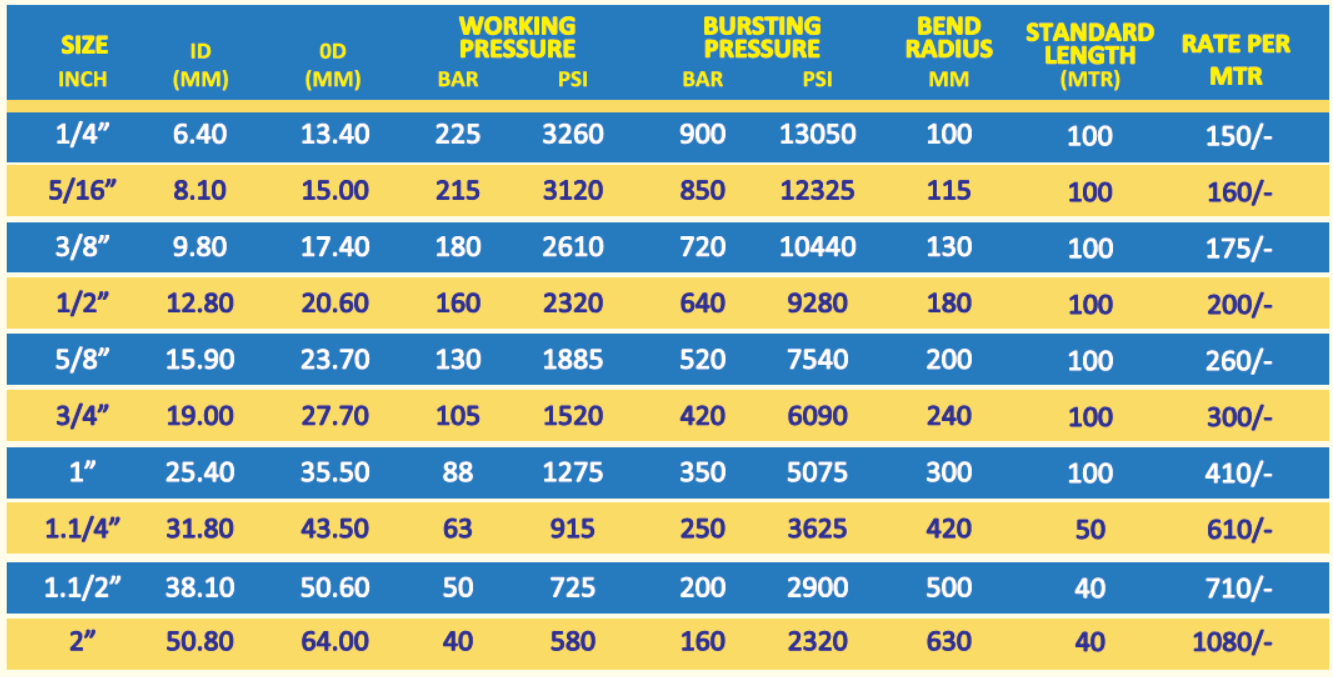
Q- What is rubber hydraulic hose used for?
A- Rubber hydraulic hose (SAE 100 R-1 AT and SAE 100 R-2 AT) is used for hydraulic lines in earthmoving and other industrial applications. The R-1 AT variant suits medium-to-high pressure lines, while the R-2 AT variant is built for high-pressure hydraulic service.
Q- What is the difference between SAE 100 R-1 AT and R-2 AT hydraulic hose?
A- Both variants share a black, oil-resistant synthetic rubber (NBR) tube and a wrap-and-smooth, oil- and abrasion-resistant synthetic rubber cover. R-1 AT uses single-braided high-tensile steel wire reinforcement for medium-to-high pressure use, while R-2 AT uses double-braided high-tensile steel wire reinforcement for higher pressure hydraulic lines.
Q- What is the temperature range of rubber hydraulic hose?
A- This hose is rated from -40°C to +100°C, with intermittent exposure up to +120°C, making it suitable for hydraulic systems used across wood, printing, textile, foundry, plastic processing, and hot-water/steam industries.